

Combination Whitening: Long-Term Results
Combination whitening is one of the most effective ways to achieve and maintain a brighter smile. It combines professional in-office treatments with at-home care to deliver immediate whitening and long-term results. Here’s what you need to know:
- In-office treatments use high-concentration hydrogen peroxide (25–40%) for quick, visible results - typically lightening teeth by 4–8 shades in a single session.
- At-home maintenance involves custom trays with lower-concentration peroxide gels (6–16% hydrogen peroxide or 10–35% carbamide peroxide) to stabilize and improve whitening over 1–2 weeks.
- Long-term benefits include reduced colour regression and better durability compared to single-method treatments. Studies show combination whitening can maintain noticeable improvements (ΔE values above 3.0) for up to two years.
- Maintenance matters: Regular touch-ups every 6–12 months and good oral hygiene habits are key to preserving results.
This dual approach not only delivers brighter teeth but also minimizes sensitivity and prevents the rebound effect often seen with in-office-only treatments. Read on to learn how combination whitening works, its clinical results, and tips for maintaining your smile.
How Combination Whitening Works
Combination whitening blends professional in-office treatments with at-home care in a phased approach. It starts with a high-concentration whitening session at the dental office, delivering noticeable results right away. This is followed by 1–2 weeks of at-home tray use to maintain and improve the initial whitening effect. This dual approach not only reduces the time spent in the dental chair but also enhances the overall results - often lightening teeth by 8–10 shades, compared to the 4–8 shades typically achieved with single-method treatments.
The in-office procedure uses high-concentration peroxide to tackle deep stains caused by factors like aging or medication. Meanwhile, the at-home phase helps prevent the "rebound effect", where teeth may darken slightly after professional treatment. Additionally, combining the two methods can better manage sensitivity, as the lower-concentration peroxide in the at-home products releases more gradually. Below, we'll explore how each component contributes to long-term whitening success.
In-Office Whitening Component
Professional in-office whitening treatments use hydrogen peroxide concentrations of 25–40%, designed to rapidly break down stain molecules through oxidation. Thanks to its small molecular size, peroxide penetrates the enamel’s porous structure - made up of about 96% mineral and 4% organic matter - to reach the deeper dentin layers where most pigments that affect tooth colour are found.
During a 90–120 minute session, the peroxide breaks down into water and oxygen radicals, targeting and eliminating stain molecules. This process can deliver an immediate improvement of 4–8 shades on the Vita classical scale, with a perceptual colour shift of ΔE 8–12. The results are primarily driven by the high concentration of peroxide and the length of application, with studies showing that light-based enhancements contribute minimally to the outcome. After this initial whitening boost, the at-home phase ensures these results are stabilized and extended.
At-Home Maintenance Component
Once the in-office session is complete, patients continue with at-home whitening using custom trays filled with gels containing 6–16% hydrogen peroxide or 10–35% carbamide peroxide for 1–2 weeks. To put it in perspective, a 15% carbamide peroxide gel delivers a bleaching effect comparable to about 5% hydrogen peroxide. While lower concentrations work more slowly, they are key to stabilizing the initial results, achieving further shade improvement, and minimizing rebound effects.
The at-home phase also supports long-term maintenance. Without additional care, teeth can lose 50–75% of their initial improvement by six months after treatment. To counteract this natural regression, periodic touch-ups with at-home products every six months can help maintain results. These touch-ups typically cost $25–$50 per month - significantly less than the $300–$600 price tag of repeating the full whitening treatment.
sbb-itb-accb75b
Long-Term Results from Clinical Studies
Clinical research highlights that combination whitening treatments deliver better long-term results compared to single-method approaches. Tracking patients over 12 to 24 months reveals that while all whitening methods show some degree of colour regression, combination treatments maintain noticeably lighter shades over time. This is largely due to the at-home stabilization phase, which allows deeper saturation of enamel and dentin. This phase significantly reduces the rebound effect often seen with in-office treatments alone. These findings provide a foundation for a closer look at colour stability measurements and treatment comparisons.
Colour Stability Measurements
To assess the durability of whitening results, researchers rely on the CIELAB colour system, using tools like the Vita Easyshade spectrophotometer. This system evaluates lightness (L*) and chromaticity (a* and b*), with the total colour change, ΔE, quantifying how far the shade has shifted from the baseline. Clinically, a ΔE value of 3.7 or higher is considered noticeable to the human eye.
Combination whitening treatments often achieve initial ΔE values between 5.0 and 10.0, depending on factors like the starting shade and carbamide peroxide concentration. Importantly, longitudinal studies show these treatments maintain ΔE values above 3.0 for up to 24 months, even without significant touch-ups. The L* value, which measures brightness, is particularly noteworthy. Combination treatments not only boost brightness but also effectively reduce yellowness (b*) over the long term.
In June 2018, researchers from the University of Chile's Department of Restorative Dentistry conducted a two-year follow-up study with 31 patients. Led by Dr. Cristian Bersezio and Dr. Eduardo Fernández, the split-mouth study compared 6% hydrogen peroxide to a 35% concentration. Using the Vita Easyshade spectrophotometer, they found that while ΔE values differed significantly between the two concentrations at the two-year mark (p < 0.05), both concentrations remained effective. Dr. Fernández commented:
"The two compounds remained effective after 2 years. An objective color difference was found between the groups, but no difference was observed in subjective reports".
Combination vs. Single Treatment Comparisons
When comparing treatment methods, the advantages of combination whitening become even clearer. In-office-only treatments deliver high initial ΔE values but often experience noticeable relapse within 6 to 12 months. Studies show that in-office whitening alone can lose up to 50% of its initial brightness within the first month due to tooth rehydration and pigment relapse. On the other hand, at-home-only treatments provide more stable results but take longer to achieve the desired shade and usually offer lower peak brightness levels.
The at-home phase in combination protocols is what sets them apart. By extending peroxide exposure over several days, this phase ensures deeper enamel saturation and minimizes the rebound effect. This approach combines the immediate results of in-office treatments with the stability of at-home methods, maintaining clinically significant whitening results for up to two years. Both spectrophotometry (ΔE values) and shade guide assessments confirm these findings. Additionally, patient surveys like OHIP-14 and PIDAQ show that combination treatments positively impact quality of life, reinforcing their long-term benefits.
Factors That Affect Long-Term Results
Combination whitening treatments are influenced by both personal habits and the natural biology of teeth. Recognizing these factors can help set realistic expectations and guide patients toward maintaining their results over time.
Lifestyle and Habits
Everyday choices, like what you eat and drink, can significantly impact the longevity of whitening results. Drinks such as coffee, tea, and alcohol contain dietary chromogens that contribute to staining over time. Smoking is another major culprit, as the pigments in tobacco easily stick to enamel, accelerating discolouration. Studies indicate that at-home bleaching results tend to last between 1 and 2.5 years, but severe initial staining can return sooner if habits that cause staining persist.
Good oral hygiene is essential for keeping stains at bay. Biofilm buildup on teeth can trap chromogens, worsening discolouration. Using abrasive whitening toothpastes or acidic mouth rinses can also roughen enamel, making it more prone to stains. As highlighted in Frontiers in Dental Medicine:
"A rougher enamel can favour the biofilm deposition and consequently increase not only the risk of caries or periodontal diseases but also the pigment retention from the diet".
To help preserve whitening results, patients should follow dietary recommendations after professional treatments and avoid smoking and alcohol during and after the process.
However, lifestyle choices aren’t the only factor at play - your enamel’s natural properties also have a big impact on how long whitening effects last.
Enamel Characteristics
The structure and composition of enamel play a major role in determining the success and durability of whitening treatments. For example, enamel thickness affects the degree of whitening. Those with thicker enamel (1.5–2.0 mm) may see an improvement of 8–10 shades, while individuals with thinner enamel typically achieve only 3–4 shades. This is reflected in colour change measurements, where thicker enamel shows ΔE values of 12–15 compared to 5–8 for thinner enamel.
Enamel is made up of 96% minerals and 4% organic material, and this balance affects its translucency. Teeth with higher organic content appear more opaque and whiter, while thinning enamel, often due to age, exposes more of the yellowish dentin underneath, making teeth appear less bright. Additionally, pre-existing sensitivity or naturally thin enamel may limit the extent of whitening that can be achieved.
Maintenance and Touch-Up Guidelines
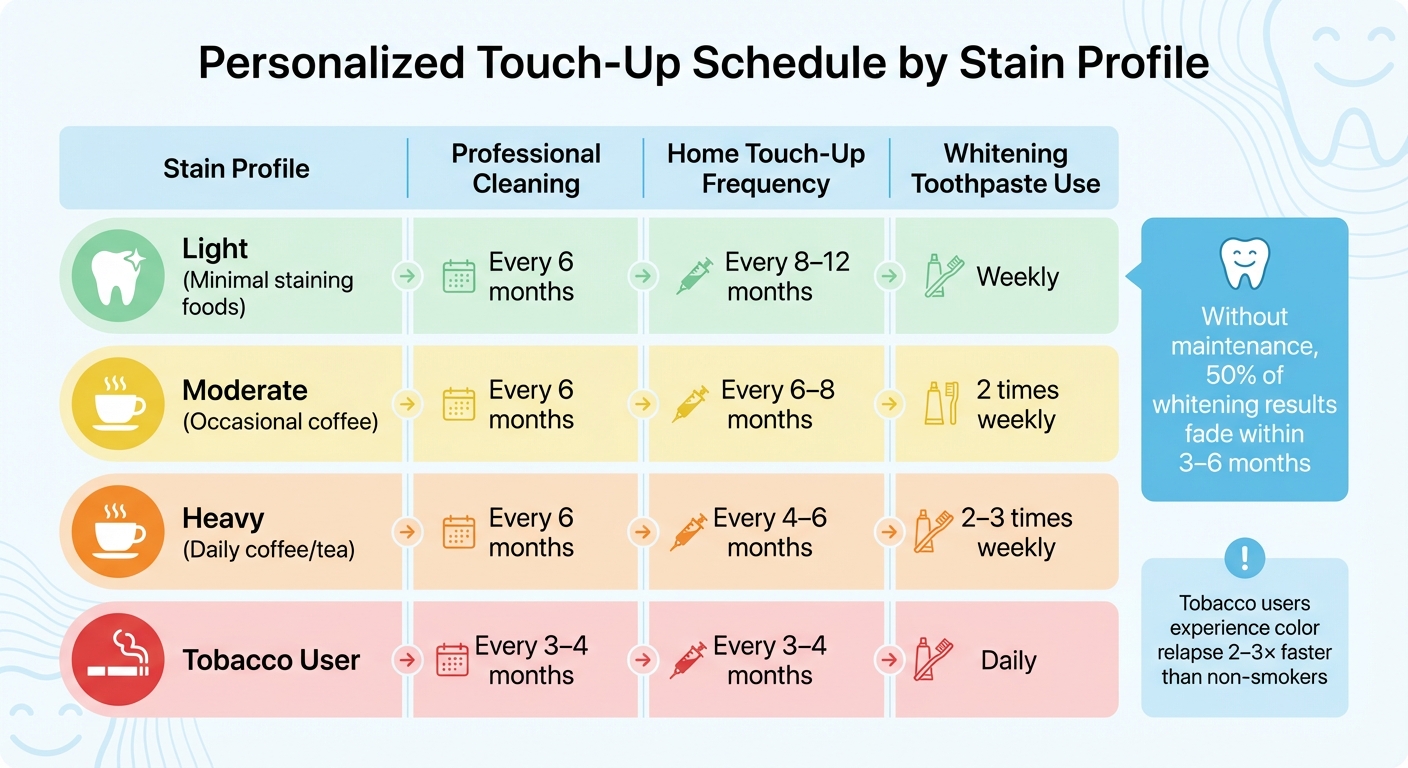
Teeth Whitening Touch-Up Schedule by Stain Profile
Teeth whitening results can fade over time, but with proper maintenance, you can extend the brightness for much longer.
Recommended Touch-Up Schedules
How often you need touch-ups depends on your habits and lifestyle. Without maintenance, studies show that about 50% of whitening results diminish within 3–6 months. By the one-year mark, most people lose roughly 75% of their whitening effect. Thankfully, professional touch-ups can restore 70–90% of the original brightness in just one session.
Combining annual or biannual professional treatments with at-home trays can reduce costs by 40–50% over five years compared to relying solely on professional care. Your ideal touch-up schedule depends on your stain profile:
| Stain Profile | Professional Cleaning | Home Touch-Up Frequency | Whitening Toothpaste Use |
|---|---|---|---|
| Light (Minimal staining foods) | Every 6 months | Every 8–12 months | Weekly |
| Moderate (Occasional coffee) | Every 6 months | Every 6–8 months | 2 times weekly |
| Heavy (Daily coffee/tea) | Every 6 months | Every 4–6 months | 2–3 times weekly |
| Tobacco User | Every 3–4 months | Every 3–4 months | Daily |
If you regularly drink coffee, tea, or wine, touch-ups every 4–6 months can help maintain your results. Tobacco users, however, experience colour relapse 2–3 times faster than non-smokers, so they require touch-ups every 3–4 months.
In addition to professional touch-ups, at-home care is essential for keeping teeth bright between visits.
At-Home Product Usage Guidelines
At-home maintenance plays a key role in preserving your whitening results. Custom-fitted trays are especially effective because they ensure even gel application and protect your gums. To maintain results, wear these trays for 1–2 nights every six months, or for one night per week over a 2–4 week period. Look for gels containing 10–15% carbamide peroxide or 4–6% hydrogen peroxide, as these are more effective than store-bought alternatives.
Use whitening toothpaste 2–3 times per week to avoid excessive enamel wear. Avoid charcoal-based toothpaste and hard-bristled brushes, which can damage enamel and lead to quicker re-staining. If you notice sensitivity, reduce how often you whiten and switch to a toothpaste formulated for sensitive teeth, preferably one with potassium nitrate.
After whitening treatments, your teeth are more porous for 24–48 hours and prone to staining. Stick to a "white diet" during this period, eating foods like white fish, chicken, rice, and cauliflower. For drinks like coffee or red wine, use a straw and rinse your mouth with water immediately afterward to minimize staining.
With the right routine, you can enjoy a bright smile for years to come.
Conclusion
Combination whitening offers a blend of immediate brightness from in-office treatments and long-term stability through at-home trays. Clinical studies show this method can lighten teeth by 8–10 shades. The at-home trays play a key role in maintaining results, helping to counteract the rebound effect and preserve the shade for 6 to 12 months.
Patient education is a cornerstone of successful outcomes. As research highlights, "The success of bleaching procedures depends mainly on the identification of the colour alteration origin, which is usually classified as extrinsic or intrinsic". Ensuring patients understand the importance of their at-home trays is crucial, as without them, up to 50–75% of the whitening effect can fade within six months. Explaining the science behind the rebound effect and the role of maintenance empowers patients to stick to their treatment plan.
This knowledge not only boosts adherence but also improves overall results. For instance, advising patients to use 5% potassium nitrate toothpaste for two weeks before treatment can reduce sensitivity by 40–50%, making the process more comfortable. Post-treatment tips, like following a "white diet" for 48 hours and scheduling touch-ups every 6–12 months, help maintain results without risking enamel damage or rapid staining.
Combination whitening stands out for delivering both quick results and long-lasting effects. Custom trays and clear aftercare instructions give patients the tools they need to protect their investment.
For dental professionals in Canada, Smile360 Teeth Whitening Canada provides expert products and training to support the success of combination whitening treatments, ensuring patients achieve and maintain their brightest smiles.
FAQs
Am I a good candidate for combination whitening?
If you’re aiming for results that stand the test of time, combination whitening could be a great option. Research backs its effectiveness, especially when blending in-office procedures with at-home treatments. Studies also point out that this approach helps maintain brighter teeth over the long term.
How long will my results last if I drink coffee or tea?
The results from combination whitening treatments can last anywhere from 2 to 3 years, provided you maintain proper oral care. However, habits like drinking coffee or tea can reduce this timeframe, as these beverages are known to stain teeth. To keep your smile bright for longer, focus on consistent and thorough dental hygiene practices.
What should I do if whitening makes my teeth sensitive?
If teeth whitening leads to sensitivity, try cutting back on how often you use the treatments or opt for a lower concentration. Overdoing it can harm your enamel, so it's best to pause or slow down and seek advice from a dentist. Switching to products with gentler formulas or those containing desensitizing agents can also help reduce discomfort without sacrificing your progress.