

How Discount Offers Bring New Whitening Clients
A small, time-limited whitening discount can bring in new clients without hurting your pricing - if I keep the offer tight, track every booking, and focus on repeat visits.
Here’s the short version:
- I use modest first-visit offers, such as $10 CAD off, instead of deep price cuts.
- I set clear booking windows and redemption rules to avoid filling peak times with low-margin bookings.
- I often add a low-cost retail item, like a $19.00 CAD whitening pen, instead of cutting more from the treatment price.
- I track rebook rate, average discount, total revenue, and new clients gained after each promo.
- If a whitening kit costs about $16.99 CAD per treatment, I need to know that number before I discount anything.
The main point is simple: discounts work best when they lower first-time risk, not when they train people to wait for deals. Many clients are unsure about price, results, or sensitivity at first. A small offer can get them to book, but the money is made only if they come back at full price.
A few facts shape the offer:
- Professional whitening can show visible results after one session
- Bundles can push the average sale from about $90.00 CAD to more than $130.00 CAD
- Flat-dollar offers are often easier to control than percentage discounts
| What I focus on | What it does |
|---|---|
| Small first-visit discount | Brings in new clients without cutting too deep |
| Retail add-on bundle | Keeps more of the treatment price intact |
| Booking limits | Helps fill slower days like Tuesday to Thursday |
| Promo code tracking | Shows which offer led to the booking |
| Rebook rate | Tells me if the promo paid off |
If I want discount offers to work, I need them to do one job: get the first booking while still leaving room for profit on the first visit and the next one.
Entry offers that attract first-time clients without cutting too deep
Percentage-off and dollar-off first-visit offers
For first-time clients, a flat-dollar discount or a small bundle usually makes more sense. A flat-dollar offer is easier to control, easier to budget, and easier to cap if costs start creeping up. By contrast, percentage-off deals can eat into margin fast.
That’s why percentage-off offers tend to work better for retail add-ons and aftercare instead of the main treatment price.
If you’d rather not discount the treatment itself, there’s a simple workaround: bundle in a retail add-on. The client feels like they’re getting more, and you avoid shaving too much off the core service.
Intro packages and value-added offers
A good example, often found in a Teeth Whitening Marketing Vault, is pairing a standard whitening treatment with a Teeth Whitening Pen priced at $19.00 CAD. It’s a small add-on, but it changes the math in a good way.
Businesses that work retail into the offer this way can move the average ticket from $90.00 CAD to over $130.00 CAD. That’s the big appeal of bundles: they tend to protect margin better than a straight price cut.
How treatment costs affect what you can discount
Your cost per treatment decides how far you can go with any offer. Before setting a first-visit deal, know that number cold. Don’t guess. Use margin to set the cap.
For example, if a treatment kit costs about $16.99 CAD per unit, your discount needs to stay low enough that the sale still makes sense. A first-visit offer should bring people in, not chip away at the money you need to keep the service worth selling.
sbb-itb-accb75b
Use booking windows and redemption rules to control demand
Once your offer is set, the rules around it matter almost as much as the discount itself. A clear booking window and simple redemption terms help keep the promo profitable, predictable, and easy to run.
Booking windows that turn interest into appointments
A booking window gives your offer a clear lifespan. Without one, people drift and put it off. Set a firm expiry date so clients have a reason to book now, not “sometime later.”
You can also limit redemptions to Tuesday through Thursday and add a subject to availability clause to protect your busiest hours. That way, the promo stays focused on the days you want to fill.
Redemption terms that protect margin and reduce confusion
Clear terms protect margin, make checkout simpler, and help you see which offer drove the first booking. Ask clients to quote the promo code at the time of booking. It keeps your team on the same page and cuts down on front-desk mix-ups.
For most clinics, the core terms are pretty simple: new clients only, one per person, not valid with any other offer, and valid only on selected in-studio whitening treatments. Those rules keep the discount aimed at first visits instead of letting it spill into places you never intended.
| Redemption Rule | Why It Matters |
|---|---|
| New clients only | Keeps the offer focused on acquisition rather than repeat discounts |
| One per person | Helps prevent misuse and protects margin |
| Not valid with any other offer | Avoids discount stacking that erodes profit |
| Quote code at booking | Supports consistent staff application and easier tracking |
| Valid only on selected in-studio whitening treatments | Prevents unintended discounts on retail products |
Put these terms on every promo card, social post, and email. Repeating the same promo code across each channel also makes tracking much easier. Add it to your booking notes so you can see which offers convert and which ones just get attention.
Track whether discount offers bring profitable new clients
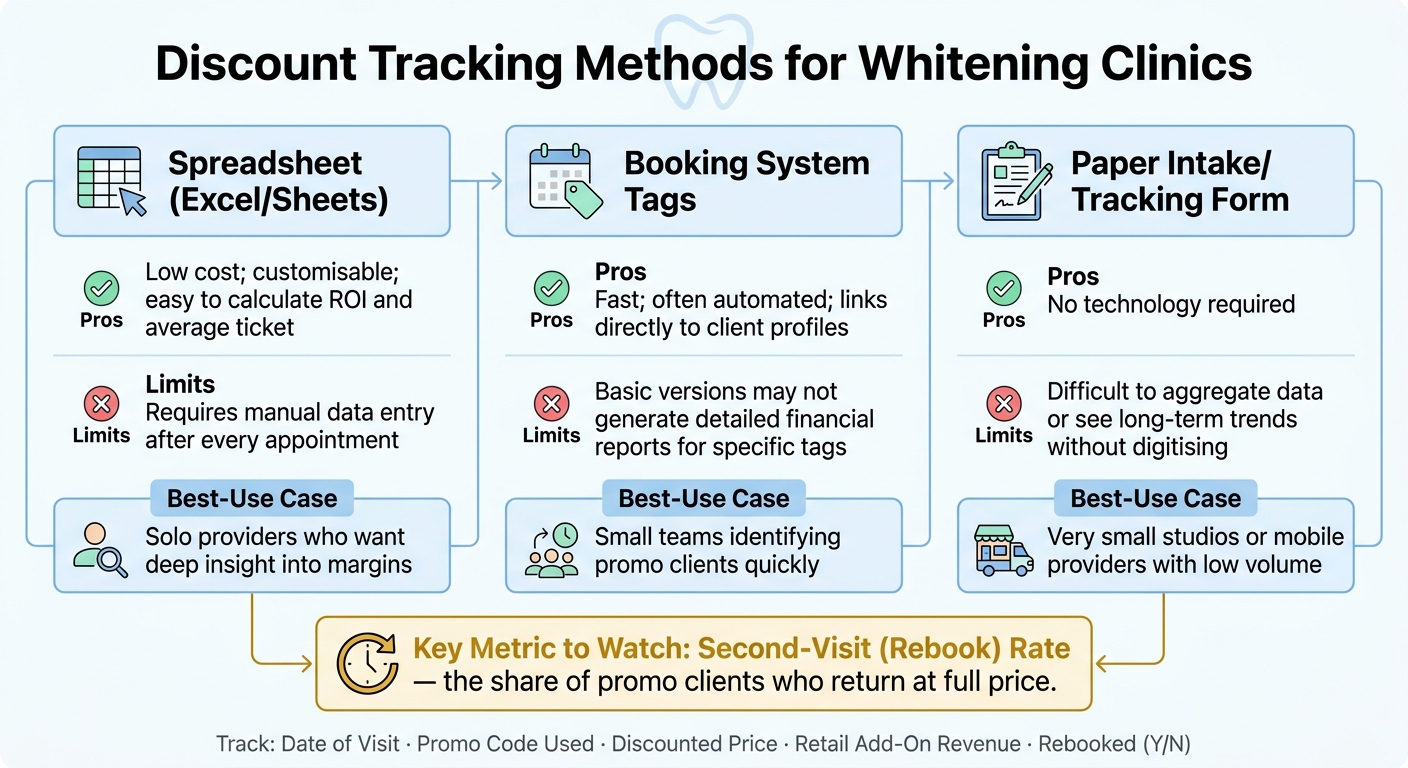
Discount Tracking Methods for Whitening Clinics: Spreadsheet vs. Booking System vs. Paper
A discount only pays off when promo clients come back and book at full price. That’s the whole game. Once you’ve set clear booking windows and redemption rules, the next step is simple: track what happened.
Simple tracking in spreadsheets or booking software
You don’t need fancy software here. For most solo providers and small teams, a basic spreadsheet does the job just fine.
Set up one row for each promo client. Then track:
- Date of visit
- Client name
- Service booked
- Promo code used
- Regular price
- Discounted price
- Retail add-on revenue
- Rebooked as a checkbox or Y/N field
It also helps to track retail add-ons on their own, instead of folding them into the service total. That way, you can see whether the promo brought in extra sales or just filled a spot on the calendar. And make sure you record whether the client rebooked.
Numbers to review after each campaign
Use the same promo code and the same booking note format every time. That keeps your tracking clean and makes one campaign easier to compare with the next.
After each campaign, review these four numbers:
- Second-visit rate: the share of promo clients who rebook at full price
- Average discount per client: total discount value divided by the number of clients
- Total revenue collected: total service revenue plus retail revenue from the campaign
- New whitening clients acquired: a baseline for future promos
| Tracking Method | Pros | Limits | Best-Use Case |
|---|---|---|---|
| Spreadsheet (Excel/Sheets) | Low cost; customisable; easy to calculate ROI and average ticket | Requires manual data entry after every appointment | Solo providers who want deep insight into margins |
| Booking System Tags | Fast; often automated; links directly to client profiles | Basic versions may not generate detailed financial reports for specific tags | Small teams identifying promo clients quickly |
| Paper Intake/Tracking Form | No technology required | Difficult to aggregate data or see long-term trends without digitising | Very small studios or mobile providers with low volume |
Only run the offer again if rebook rates are strong and total revenue covers your cost per session. If not, the promo may have brought in bookings without bringing in enough profit. The numbers will tell you which offers are worth keeping.
Conclusion: Build offers that win first visits and support repeat business
Once your offer, booking window, and redemption rules are set, the last thing to check is simple: does the promo bring in clients who are worth winning again?
The best offers tend to be modest, time-limited, and clearly reserved for new clients. That keeps the deal from eating into your margin while still giving people a good reason to book that first visit. If the offer brings in first appointments without cutting too deeply into profit, it’s doing its job.
Smile360 Teeth Whitening Canada offers starter kits, gels, training, and promo tools to help salons and solo providers run controlled first-visit offers.
FAQs
How much should a first-visit whitening discount be?
A $10 discount is a strong entry offer for first-time teeth whitening clients. It can help bring in bookings without getting too hard to manage if your average session revenue sits around $90 to $100.
To protect your margins, pair it with a second offer, such as 10% off at-home care products. That can help drive retail sales and lift the average ticket.
Should I offer a bundle instead of a bigger discount?
Often, yes. A bundle can work better than a bigger discount because it protects your profit margin while nudging up the average sale.
Take a simple example: pair a whitening session with an at-home care kit. The client gets more value they can see right away. A flat discount just cuts into your direct revenue. A 2-in-1 offer, on the other hand, can help drive both service bookings and retail sales.
Which numbers matter most after a promo ends?
Track average client ticket value and total annual revenue. These numbers show whether promo clients later book full-price services or buy retail at-home whitening products.
For context, base session revenue often sits around $90 to $100 per client. But when retail add-ons are part of the sale, ticket value can climb to $130 or more. That gap matters.
Review these figures on a regular basis. It helps you see whether the discount is feeding long-term profit, not just bringing in a short burst of traffic.