

How to Price Teeth Whitening Packages in 2026
I price 2-, 3-, and 4-session whitening packages by calculating every visit’s cost, then checking local rates and profit per booked hour. For example, a package costing $180 CAD needs a $300 pretax price to reach a 40% margin - if payment fees are already included in that cost.
Here’s what I check before publishing prices:
- Costs: Gel, supplies, labour, equipment, overhead, and booking fees, using current invoices and realistic appointment numbers.
- Profit: A 35%–45% fully loaded margin target, plus enough contribution per booked hour.
- Discounts: Each package must clear its price floor. More visits don’t automatically justify a bigger discount.
- Terms and rules: Taxes, cancellations, refunds, unused visits, treatment limits, and provincial requirements.
I count one session as <u>one booked visit</u>, not one gel application. And I keep one point clear: a package price is not a promise of results or a reason to recommend more treatment.
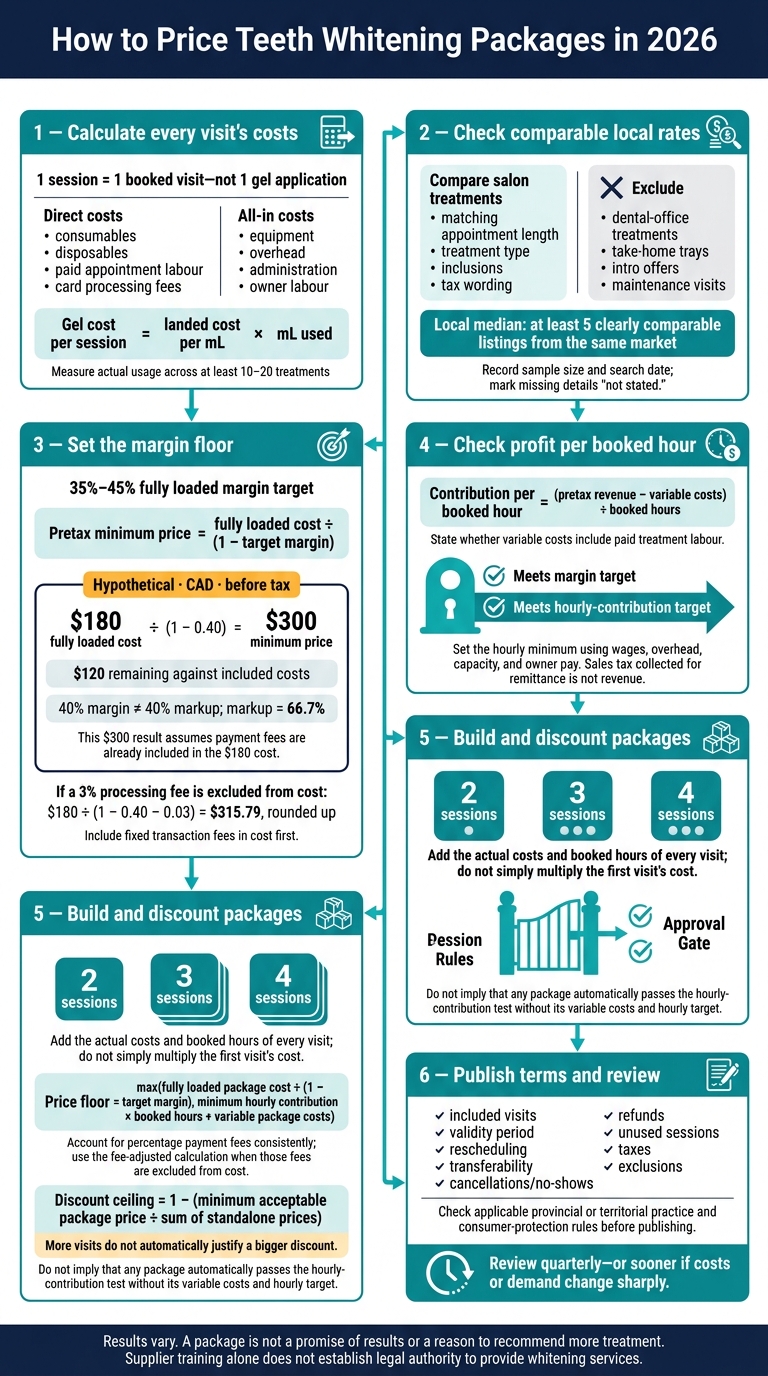
How to Price Teeth Whitening Packages in 2026
Calculate the Cost of Each Whitening Session
Create a worksheet for each treatment type, then use your session costs to price 2-, 3-, and 4-session packages. Track direct cost and all-in cost separately. Direct cost covers consumables, disposables, paid appointment labour, and card processing fees. All-in cost adds equipment, overhead, administration, and owner labour.
Record invoice dates, quantities, and usage so you can update costs without rebuilding the worksheet. Start with direct costs, then add labour and overhead.
Track Gel, Supplies, and Appointment Time
Calculate gel cost per session = landed cost per mL × mL used. Measure actual usage across at least 10–20 treatments. Keep separate records for standard, sensitive, touch-up, and re-treatment appointments.
Include every disposable: gloves, retractors, applicators, bibs, and disinfecting wipes. Allocate reusable equipment separately rather than counting it as a disposable supply.
Record consultation, setup, treatment, sanitation, turnover, and admin time separately in minutes. Track staff time and room time as separate costs. Your labour rate should include wages, vacation pay, employer payroll costs, and benefits. Keep owner labour on its own cost line, and never count the same hours twice.
Account for Equipment, Overhead, and Booking Costs
Add machine purchase, installation, and maintenance costs, subtract residual value, then divide by a realistic number of lifetime treatments.
Allocate rent, utilities, insurance, software, training, and marketing across expected completed appointments, not full capacity. Where appointment lengths differ, allocate costs by room time.
Include documented allowances for waste and re-treatment, plus actual payment fees on the amount charged. Account for cancellations through realistic booking volume - don’t add the same loss again as a reserve. Check that software charges, equipment costs, and bundled supplies appear only once.
Base Supply Costs on Current Invoices
For gels, treatment kits, machines, disposables, and training purchased from Smile360 Teeth Whitening Canada, use current paid invoices, not older advertised prices.
Calculate landed unit cost = (purchase cost after discounts + allocated shipping + non-recoverable taxes) ÷ usable units.
Record recoverable GST/HST separately. Keep equipment, consumables, and training in separate categories, and never estimate usable treatments from a starter-kit price.
Treat the per-session cost as your pricing floor when checking local market rates and setting your package margin.
sbb-itb-accb75b
Check Local Rates and Set Profit Targets
Compare Local Prices and Treatment Details
Once you’ve set your fully loaded session cost, compare it with local prices to see where your service sits. Check dated public listings in your service area for CAD prices, appointment length, treatment type, inclusions, tax wording, and introductory or membership conditions. Mark any missing details as “not stated.”
Compare salon treatments only. Exclude dental-office treatments, take-home trays, intro offers, and maintenance visits. If a listing says “two sessions,” check whether that means two appointments or two rounds in one visit.
Calculate a local median only when you have at least five clearly comparable listings from the same market. State the sample size and search date. Label the prices as public examples, not averages, and use the comparison to help set your margin target.
Calculate Your Minimum Package Price
Use a 35%–45% fully loaded margin target and calculate each package separately:
Pretax minimum price = fully loaded cost ÷ (1 − target margin)
Margin is profit divided by revenue. Markup is profit divided by cost. They’re not the same.
Hypothetical three-session calculation: At $180 in fully loaded cost and a 40% target margin, the minimum price is $300, leaving $120 against the included costs. That is a 66.7% markup, not a 40% markup. If percentage processing fees are excluded from the $180 cost, a 3% fee changes the calculation to $180 ÷ (1 − 0.40 − 0.03) = $315.79, rounded up. Include fixed transaction fees in cost first.
Once you’ve calculated the margin floor, check whether the package also meets your target per booked hour. Calculate hourly contribution as:
Contribution per booked hour = (pretax revenue − variable costs) ÷ booked hours
State whether variable costs include paid treatment labour, along with gel, disposables, and payment fees. Base your hourly minimum on wages, overhead, capacity, and owner pay. Don’t count sales tax collected for remittance as revenue.
Test both targets against slow bookings, gel waste, and package discounts. Approve prices only when your 2-, 3-, and 4-session packages cover costs and meet your profit targets.
Set Prices for 2-, 3-, and 4-Session Packages
Build each package price from the full cost of every visit, rather than multiplying the first visit’s cost. Add up the visit costs and booked hours, then use the standalone prices from the previous section to compare each package.
Check every package against your earlier margin and hourly-contribution targets. The package floor is the higher of these two amounts:
Price floor = max(fully loaded package cost ÷ (1 − target margin), minimum hourly contribution × booked hours + variable package costs)
Check local standalone prices, then use these floors to set your package offers.
Hypothetical package examples: All amounts are in CAD, before tax.
Package Session mix Fully loaded cost Booked hours Sum of standalone prices Package price Discount Fully loaded margin 2 sessions Initial + follow-up $128.25 2.25 h $300 $285 5.0% 55% 3 sessions Initial + 2 boosters $172.80 2.75 h $400 $360 10.0% 52% 4 sessions Initial + 3 boosters $216.75 3.25 h $500 $425 15.0% 49%
Replace these figures with your salon’s costs, appointment lengths, and local standalone prices. A package doesn’t prove a client needs more sessions or guarantee results.
2 Sessions: Test a Small Discount
Start with a 5%–10% discount on the smallest package. Check that the price clears your margin floor and meets your hourly-contribution target. The second appointment must still follow your consultation, contraindication, sensitivity, and spacing protocols.
3 Sessions: Price Boosters by Their Costs
Price boosters by the resources they use - not just their shorter appointment times. Each booster still carries full service costs. Calculate gel and machine use separately, and count owner labour as a cost, not free profit. Check the three-session price against both your margin floor and hourly-contribution target.
4 Sessions: Set a Discount Limit and Package Terms
Use the largest package to set your discount limit and written terms. Calculate the limit with this formula:
Discount ceiling = 1 − (minimum acceptable package price ÷ sum of standalone prices)
If the ceiling is negative or leaves too little room for a discount, revisit the session mix, costs, standalone prices, or package concept. Don’t lower your margin target just to offer a discount.
Put the package terms in writing: the number and type of visits, validity period, rescheduling rules, transferability, cancellation or no-show fees, refunds, treatment of unused sessions, taxes, and excluded products or add-ons.
Before setting an expiry date or a restrictive refund condition, check the applicable provincial consumer-protection rules. Clearly state whether GST/HST is included or added separately.
Conclusion: Review Costs, Profits, and Package Terms
Before publishing prices, check each package against your cost floor, local rates, and profit target. Use current invoices to account for actual gel use, disposables, labour, fees, and overhead. Spread equipment costs across realistic bookings, allowing for maintenance and downtime - not maximum machine capacity.
Make sure local price comparisons reflect the same treatment length and inclusions. Approve discounts only if each package still meets your margin floor and contribution-per-hour target. Confirm how taxes apply before publishing prices.
Your written terms should match what you can deliver. Set out appointment availability, included products, and what happens if treatment must stop for safety reasons. State that results vary, and don’t promise a particular shade.
Before launch, check provincial or territorial practice rules, insurance terms, and local business obligations. Professional training alone does not establish legal authority to provide whitening services.
After launch, review pricing quarterly - or sooner if costs or demand change sharply. Track costs, completions, cancellations, refunds, and hourly contribution, and recheck local rates. Keep dated rate sheets and cost records so staff charge current prices.
FAQs
How should I price packages when clients need different gel amounts?
Calculate your base cost per session using the gel volume needed - typically around 0.5 mL per arch - plus overhead and disposable supplies. Track how much gel you use for each client to keep billing accurate.
For tiered packages, factor different gel amounts into the total cost, then price each package to meet your target profit margin. Consistent tracking helps keep margins steady while accounting for each client’s sensitivity level and clinical needs.
Should I honour existing packages when my costs rise?
When operating costs go up, update your package pricing promptly rather than absorb the loss. Even small shifts in supply prices or booking volumes can quickly eat into your profit margins.
Review your budget at least monthly - and more often when costs are climbing. Build a 10% buffer into your calculations, then test higher supply-cost scenarios to check that your pricing still leaves room for profit.
How should I calculate refunds if treatment stops for sensitivity?
State your refund policy clearly in signed consent forms and service agreements. You decide how to calculate refunds, but account for kit components, disposables and appointment time already used. Consider a partial refund based on unused sessions, or offer credit towards future, gentler treatments with lower-concentration or non-peroxide gels.
Record why treatment stopped, the symptoms reported and the final resolution in the client’s digital file.