

Laser Whitening vs Trays: What Study Data Shows
I wouldn’t choose laser whitening on the promise of whiter teeth. A review of 21 randomized trials found no clear difference in final colour between office bleaching with and without light - not a direct laser-versus-tray comparison. Before choosing, I’d check the peroxide protocol, sensitivity risk, treatment time and provincial rules.
Quick Comparison
| What I’d compare | Laser-assisted office whitening | Dentist-prescribed trays |
|---|---|---|
| Final shade | No reliable shade advantage from adding light | A 90-person trial found similar bleaching to office treatment. |
| Sensitivity | Can occur; laser findings vary | Can occur; gel strength, fit and wear time matter |
| Time | Usually one visit; some protocols use two | Repeated wear over days or weeks |
| Lasting results | Immediate colour can reflect dehydration | Assess after the prescribed course |
| Setup and cost | Device, compatible gel, protection and training | Fitted trays, prescribed gel and clear wear instructions |
Peroxide does the bleaching - not the light alone. Neither method whitens crowns, veneers or fillings.
For a Canadian service launch, I’d put <u>legal scope and client safety before equipment</u>: confirm provincial requirements, product compliance, screening, consent, dental referrals and follow-up. I’d also budget in CAD for supplies, training, insurance and maintenance. Supplier training alone does not permit you to provide treatment.
Professional teeth whitening trays vs laser whitening
sbb-itb-accb75b
What Studies Show About Laser Whitening and Trays
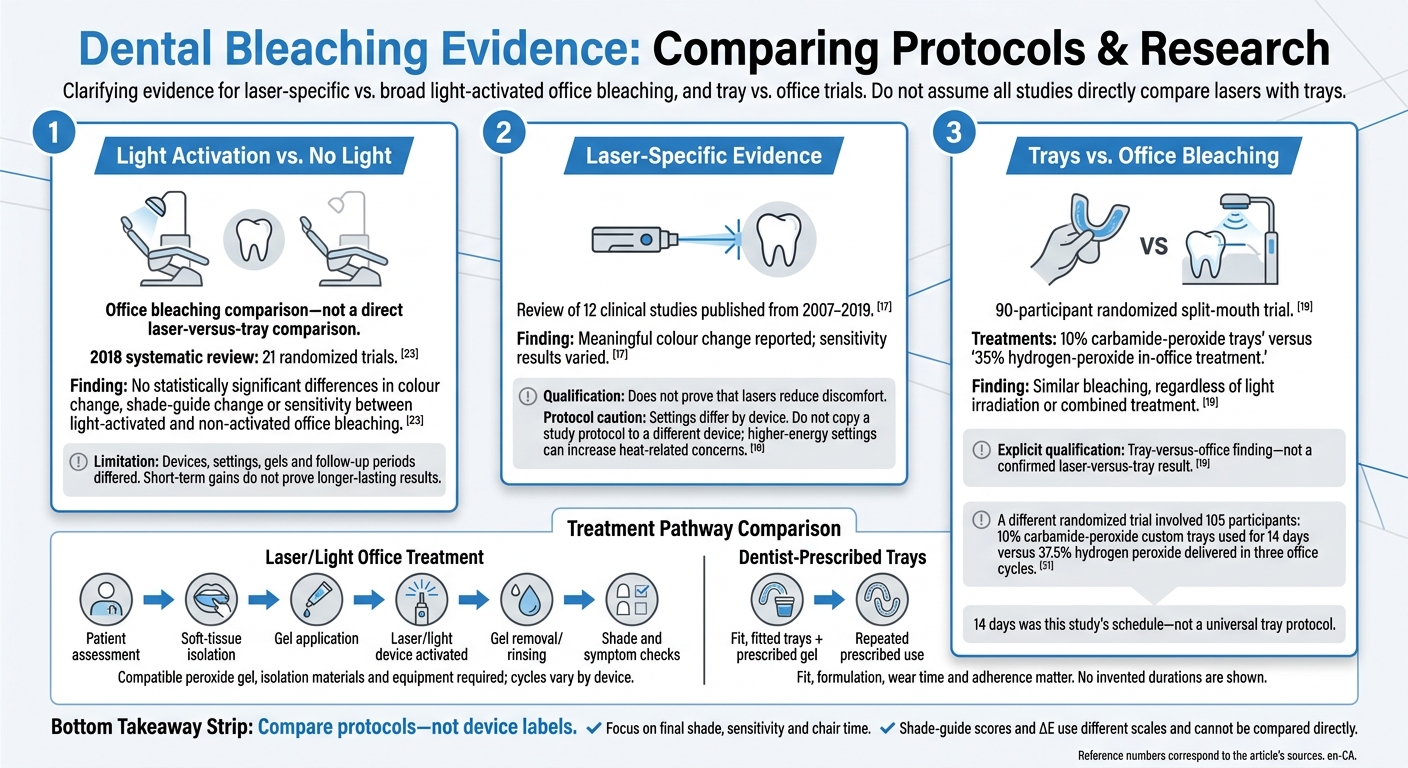
Laser Whitening vs Trays: What the Evidence Actually Compares
Most studies compare light-activated office bleaching with the same treatment without light - not lasers directly with trays. When planning services, focus on final shade, sensitivity and chair time.
Laser Whitening Results and Treatment Steps
A laser-specific review of 12 clinical studies published from 2007–2019 reported meaningful colour change. Sensitivity results varied, though, so the review does not prove that lasers reduce discomfort. For practice owners, the question is whether the results justify the added device and training costs. Shade-guide scores and ΔE measure colour on different scales and cannot be compared directly.
Treatment usually involves assessment, soft-tissue isolation, gel application, laser or light activation, gel removal and rinsing, followed by shade and symptom checks. Settings differ by device, so a protocol from one study should not be copied to another device. Higher-energy settings can increase heat-related concerns.
| Method or evidence group | Shade change and stain response | Schedule and equipment | Follow-up and evidence gaps |
|---|---|---|---|
| Laser/light-activated office bleaching | A 2018 systematic review of 21 randomized trials found no statistically significant differences in colour change, shade-guide change or sensitivity between light-activated and non-activated office bleaching. Laser-specific sensitivity results vary. | Peroxide gel, isolation materials and compatible light or laser equipment; cycles vary by device. | Differences in devices, settings, gels and follow-up periods limit comparisons. Short-term gains do not prove longer-lasting results. |
| 10% carbamide-peroxide trays | In a 90-participant split-mouth trial, trays produced similar bleaching to 35% hydrogen-peroxide in-office treatment. | Fitted trays and repeated prescribed use; adherence matters. | Results depend on tray fit, formulation and participant selection. |
The device label alone tells you less than the treatment protocol.
Tray Whitening Results and Application Schedules
The 90-participant randomized split-mouth trial found similar bleaching with 10% carbamide-peroxide trays and 35% hydrogen-peroxide in-office treatment, regardless of light irradiation or combined treatment. This is a tray-versus-office finding, not a confirmed laser-versus-tray result.
A 105-participant randomized trial compared 10% carbamide-peroxide custom trays used for 14 days with 37.5% hydrogen peroxide delivered in three office cycles. Those 14 days describe the study schedule - not a universal tray protocol.
In service records, document gel strength, wear time, completed uses and the shade-assessment date. Compare results at matching post-treatment intervals. Also, separate unusual staining from routine whitening outcomes before making claims.
Beyond final shade, the next comparison looks at how predictable results are across appointments.
Comparing Sensitivity, Treatment Time, and Lasting Results
Shorter laser appointments don’t necessarily mean better results than longer tray treatments. Compare results at matching time points, and keep laser findings separate from broader light-activation research.
| Outcome | Evidence and observation period | Limits for service planning |
|---|---|---|
| Whitening results | A 2021 trial assigned 80 participants to 40% hydrogen peroxide activated with Nd:YAG laser, diode laser, LED, or no light. All groups changed colour, and the no-light group still showed a measurable change at 6 months. | The trial did not directly compare trays; six-month results do not establish permanent whitening. |
| Early colour change | Researchers measured colour immediately, at 2 weeks, 1 month and 6 months. The clearest early change appeared at 2 weeks. | Immediate readings alone cannot establish the final result. |
| Treatment duration | In-office treatment used three 10- or 15-minute applications, sometimes across one or two appointments. Tray wear ranged from about 1–8 hours daily for 14 days to 3 weeks. | These tray schedules offer a comparison, not instructions for every client. |
| Sensitivity | Pooled light-versus-no-light evidence found no statistically significant difference in incidence: RR 1.0, 95% CI 0.8–1.3. | This is indirect evidence, not a direct laser-versus-tray estimate. |
Sensitivity Rates and Risk Factors
Incidence means how many clients react; severity means how strong the reaction is; duration means how long it lasts. One “sensitivity rate” cannot describe all three. Differences in pain scales and assessment times also make comparisons harder.
Sensitivity deserves its own discussion alongside shade change, especially when clients weigh office visits against home treatment.
| Evidence | Incidence | Severity | Duration or observation window |
|---|---|---|---|
| Lower-concentration tray comparison | Percentage not reported | 10% carbamide peroxide produced the smallest increase in sensitivity; 40% hydrogen peroxide produced the greatest. | Early symptoms were assessed, including on the first day; a complete duration estimate was not supplied. |
| Light versus no light | RR 1.0: no statistically significant difference | Mean difference −1.6, 95% CI −3.4 to 0.2: no statistically significant difference. | Observation windows varied across protocols. |
| American Dental Association guidance | Up to two-thirds of bleaching users may experience sensitivity; this is not a tray-versus-laser rate | Generally mild and temporary | Tray or strip symptoms commonly begin within 2–3 days and resolve around day 4 after treatment ends. |
When screening clients, look beyond the device label. Peroxide strength and tray fit are more useful guides to risk. Higher concentrations, longer or repeated exposure, exposed roots, existing hypersensitivity and poorly fitting trays can increase that risk.
Check for enamel cracks, gingival recession, caries and defective restorations rather than expecting activation to prevent discomfort. Some light protocols caused greater sensitivity at 24 hours despite similar symptoms immediately after treatment. Follow-up should extend beyond the appointment.
Appointment Length vs Full Treatment Course
Gel-contact time is not total appointment time. Chair time also includes assessment, isolation, gel removal and checks. For home treatment, count total wear time across all treatment days. Set client directions using the product instructions - not a study’s schedule.
| Planning point | Laser/light office protocol | Tray protocol |
|---|---|---|
| Time commitment | Application minutes within one or two appointments, as outlined above. | Daily wear across 14 days to 3 weeks, as outlined above. |
| Supervision and adherence | The operator controls isolation, application and timing | Results depend more on fit, correct wear time and completion of applications |
| Sensitivity management | Check symptoms during treatment and afterwards | Give clear instructions for reporting symptoms, pausing treatment and seeking reassessment |
| Colour checks and maintenance | Record immediate readings separately from later readings taken after teeth rehydrate | Assess after the prescribed course; reassess before repeat treatment instead of scheduling automatic touch-ups |
Visible Colour Changes, Stain Types, and Study Limits
A statistically significant colour change may not be visible to a client. Shade-guide steps, ΔE values and client ratings measure different things and cannot be used interchangeably. Dehydration can also make teeth look temporarily whiter than the lasting result.
Differences in light sources, peroxide strengths, follow-up times and internal stains - including tetracycline-related discolouration, trauma and fluorosis - limit comparisons and promises of predictable results. Don’t market lasers as a treatment for every stain. Crowns, veneers and fillings do not whiten, so a dental assessment is needed to address possible colour mismatches. Service claims, consent discussions and referral decisions must reflect these limits.
Canadian Safety Rules and Service Setup
Study findings help assess performance, but launch decisions depend on legal requirements and service procedures. Research does not prove that a non-dental operator can legally provide whitening. The CDA recommends bleaching under a dentist’s care. Its guidance says current literature does not show that power- or light-assisted methods produce whiter teeth, although they may shorten treatment time. This is professional guidance - not a complete statement of Canadian law.
Client Screening, Consent, and Dental Referral
Use a written intake form to screen for pain, persistent sensitivity, cracked teeth, suspected decay, gum disease, exposed roots, enamel defects, recent dental treatment, allergies, previous reactions, and an unclear cause of staining. Include pregnancy or breastfeeding when listed in the product instructions. Refer clients with concerns to a dentist rather than trying to diagnose or treat them.
Written informed consent should identify the product, active-ingredient concentration, intended use, expected colour change, possible temporary sensitivity or gum irritation, alternatives, and contraindications. It should also explain that restorations may not whiten. Record screening answers, consent, shade results, photos where permitted, the product’s lot number and expiry date, treatment time, device settings, operator, and any adverse reactions.
Product Compliance and Provincial Practice Rules
Confirm the product category, formulation, intended users, claims, and labelling with Health Canada. Its guidance states that tooth-whitening products must have a pH greater than 4.00 when tested as applied to the teeth. Products containing more than 3% w/w hydrogen-peroxide equivalent require salivary-peroxide safety evidence from a clinical study. Verify Health Canada’s current wording before using these thresholds.
Federal product compliance does not grant permission to provide treatment. Local scope-of-practice and advertising rules still apply. Check provincial or territorial rules, municipal bylaws, insurer requirements, supervision requirements, advertising rules, infection control, and equipment limits. Document procedures for cleaning, instrument processing, and waste handling. Advertising must not suggest that you provide dental diagnosis or supervision when you do not.
Supplies, Training, and Costs in CAD
Once compliance is addressed, plan for training, equipment, and supplies.
Smile360 Teeth Whitening Canada offers wholesale gels, kits, machines, protective supplies, and online training. Before ordering, confirm the device type, gel compatibility, required protection, and written instructions. Supplier certification is not a professional licence or proof of clinical results.
Build a budget in CAD that covers equipment, consumables, training, insurance, maintenance, records, and follow-up time. Before setting prices, obtain dated quotes that include GST/HST, applicable provincial tax, shipping, and recurring supply costs.
Conclusion: Choosing a Method Before Launch
Your launch decision depends on protocol control, legal scope, and your ability to provide follow-up care. Study data show no universal winner: results depend on the exact protocol, not the device label. Choose a method you can legally offer in your province or territory, backed by proper screening and reliable follow-up.
Pre-Launch Checklist for Owners
Before taking bookings, check these four areas:
- Authorization: Confirm your permitted scope, required dental oversight, and referral arrangements. If you are not a dental professional, you can find a provider to handle clinical aspects.
- Safety: Check product compliance, device–gel compatibility, staff skills, and required protection.
- Client care: Test screening and referral procedures. Prepare consent materials, sensitivity instructions, and follow-up plans.
- Accountability: Review record-keeping and incident reporting. Make sure your claims are realistic and supported by evidence for the exact protocol.
Buying equipment or completing supplier training alone does not authorize you to offer a whitening service. Address any gaps with the relevant regulator, insurer, and qualified dental adviser before launch.
FAQs
Which whitening method suits my type of staining?
Surface stains from coffee, tea, wine, or tobacco respond well to both laser whitening and tray treatments. Deeper stains caused by ageing, genetics, or medications may need more intensive treatment or a longer treatment period.
Laser whitening is often preferred for faster results. Trays with non-peroxide or lower-concentration peroxide gels suit sensitive teeth or those who prefer a gradual approach. Before choosing, have a dental professional assess your dental health and any existing dental work.
When should sensitivity prompt a dental visit?
Some tooth sensitivity is normal for 24 to 48 hours after whitening. Contact your dentist if it lasts longer than 48 to 72 hours or the discomfort gets worse. They can assess your oral health, check for underlying problems, and suggest ways to keep you comfortable and safe.
How can I verify whitening claims before buying equipment?
Check that your supplier has submitted a Cosmetic Notification Form (CNF) to Health Canada. They should also provide Safety Data Sheets (SDS), technical data on peroxide levels, and laboratory reports confirming a pH of at least 4.0. Keep advertising claims in line with documented evidence, and avoid therapeutic promises.
Keep equipment calibration and maintenance logs to support safety standards and warranty claims.