

Ultimate Guide to Whitening Business Budgeting
If I don’t know my cost per session, break-even point, and cash buffer, I’m guessing - not budgeting.
For a teeth whitening business in Canada, I’d build my budget around 4 things first: startup costs, monthly costs, pricing, and cash flow. The numbers in this guide show a wide range: a small mobile setup can start with a much lower spend, while a studio can run into the $30,000 to $50,000+ CAD range. On the income side, average visit value can reach about $189 CAD with aftercare upsells, and even a simple break-even model can show how few or how many sessions I need each month to cover costs.
Before I spend anything, I’d pin down:
- My model: in-studio, mobile, or hybrid
- My startup spend: equipment, training, registration, insurance, inventory, and a 10% to 20% buffer
- My monthly costs: rent or storage, software, phone, marketing, fuel, processing fees, and supplies
- My session economics: price per booking, variable cost per treatment, and contribution margin
- My cash plan: slower winter weeks, busy wedding and graduation periods, and at least a few months of runway
A few numbers stand out right away:
- Mobile fixed costs can start around $1,500/month
- Teeth whitening marketing can start at about $300/month
- Training can start at $199.99 CAD
- Mobile starter kits can start at $499.00 CAD
- Studio starter kits can start at $1,299.00 CAD
- Opening stock should often cover 30 to 50 sessions
- A simple sample break-even model showed about 3.9 sessions/month
How Much Does Starting A Teeth Whitening Business Cost in 2025
sbb-itb-accb75b
Quick comparison
| Setup | Startup spend | Monthly costs | Main trade-off | Fit |
|---|---|---|---|---|
| In-studio | Higher | Higher | More overhead | One location, higher per-session ceiling |
| Mobile | Lower | Lower | Travel cuts booking capacity | Solo start, low fixed spend |
| Hybrid | Mid-range | Mid-range | Split focus across service types | Service plus retail sales |
The bottom line: I’d treat this budget as a working tool. If costs shift, bookings slow, or supply prices change, I’d update the numbers right away instead of waiting until the month ends.
Choose a business model and set financial targets
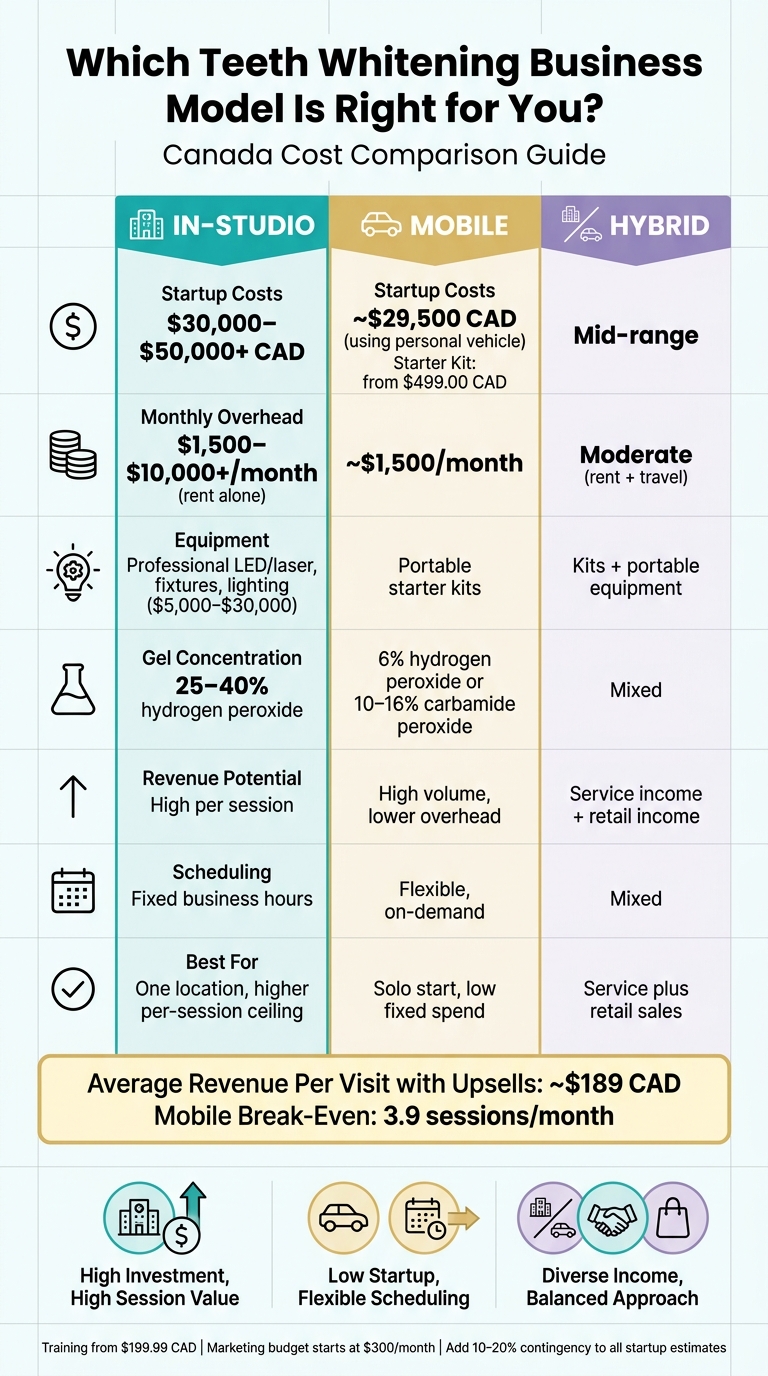
Teeth Whitening Business Models: Startup Costs & Monthly Overhead Compared
Your business model shapes almost everything: startup costs, monthly overhead, and how much you can charge. So before you map out spending or set revenue targets, pick the setup first. For a teeth whitening business, that usually means choosing between a fixed studio, a mobile service, or a mix of both.
Compare in-studio, mobile, and hybrid whitening setups
Each setup has its own cost profile, and that shows up across your budget, from launch costs to pricing per session.
| Cost Category | In-Studio | Mobile | Hybrid |
|---|---|---|---|
| Startup Costs | High (rent, leasehold improvements, professional LED or laser equipment) | Low (starter kits and portable equipment) | Moderate (equipment + kits) |
| Monthly Overhead | High (rent, utilities, insurance) | Low (travel, storage, marketing) | Moderate (rent + travel) |
| Scheduling | Fixed business hours | Flexible, on-demand | Mixed |
| Gel Concentration | High (25–40% hydrogen peroxide) | Lower (6% hydrogen peroxide or 10–16% carbamide peroxide) | Mixed |
| Revenue Potential | High per session | High volume, lower overhead | Service income + retail income |
In plain terms, mobile setups work well for operators who want lower startup costs. Studio models fit businesses aiming for more bookings in one place. Hybrid setups add another angle: retail sales alongside service income. Smile360 offers mobile starter kits that can help keep startup costs manageable for mobile operators.
The trade-off comes down to capacity. A mobile model may cost less to start, but time on the road can eat into your day. If each visit includes travel, you can book fewer sessions. That matters when you're trying to hit break-even.
Define your client mix and revenue goals
Not every booking adds the same amount to your bottom line. A more grounded revenue plan splits clients into service tiers: 35% Express sessions at $120, 40% Advanced sessions at $180, and 25% Premium or bridal bookings at $250. Add a $25 aftercare upsell to each sale, and average revenue per visit climbs to about $189 CAD.
That mix matters because it gives you a clearer picture of what a full calendar is worth. It also keeps you from leaning too hard on top-tier bookings that may be harder to fill every week.
Repeat clients make a big difference too. Maintenance customers who come back 3–4 times per year can push customer lifetime value higher. In a single-technician mobile setup running at target capacity, a Year 1 annual revenue goal of about $393,120 CAD is achievable, with EBITDA of around $62,000 CAD.
The big limiter isn't just demand. It's capacity. You can have interest in the market and still miss break-even if your schedule can't handle enough appointments. Use these figures as a benchmark, then adjust based on your market, pricing, and the number of days you plan to operate.
These targets determine how much you can safely spend on startup.
Calculate startup costs for a whitening business
Once you know your revenue targets, you can work backward and see what you can spend at launch. Start with fixed setup costs, then add a cash buffer for the first few months. A practical startup budget has two parts: one-time setup costs and a three-to-six-month operating buffer to cover expenses before bookings become steady.
Budget for equipment, training, and business setup
Your startup budget should cover a few core items:
- Equipment: whitening machine (LED lamp), protective eyewear, and sanitary supplies
- Business registration: $60–$300 depending on your province, or $200 for federal incorporation
- Liability insurance: often $50–$300 per month
- Training and certification: Smile360's Online Training Course is $199.99 CAD and includes a training manual, waiver templates, and certification
If you want a bundled launch, Smile360 offers mobile starter kits at $499.00 CAD and $699.00 CAD, plus studio or salon starter kits from $1,299.00 CAD. These include a full system, training, and marketing resources. That kind of bundle can make setup simpler and help you keep spending under control.
Location is the next big cost driver, especially if you're setting up a studio.
Plan opening inventory, compliance, and location costs
Your opening inventory should cover 30 to 50 sessions before you need to reorder. That means stocking gels, kits, disposables, and aftercare products from day one. You’ll also want to use Health Canada-compliant gels to meet safety and regulatory rules. Smile360 carries both non-peroxide (natural/vegan) and 35% carbamide peroxide options, which gives you a way to serve clients with different sensitivity levels.
| Cost Category | In-Studio | Lean Mobile (Solo) |
|---|---|---|
| Space | $1,500–$10,000+/month (lease) | $0 (home-based storage) |
| Equipment Setup | $5,000–$30,000 (fixtures, lighting) | Core portable kit |
| Storage | Included in lease | ~$700/month (storage unit, if needed) |
| Vehicle | Not applicable | Personal vehicle ($0 to start) |
| Total CAPEX Range | $30,000–$50,000+ | ~$29,500 |
If you're starting mobile, using your personal vehicle can save you from the biggest single expense in a branded mobile setup. A dedicated van costs around $45,000.
It also helps to add a 10–20% contingency on top of your total startup costs. That extra room can cover emergency repairs, surprise legal fees, or a slow first month. At $100 profit per client, about 13 clients can cover a $1,300 launch investment. That gives you a simple way to gauge how much runway you have before monthly operating costs kick in.
Build a monthly operating budget and control costs
Startup costs get you off the ground. Your monthly budget tells you if the business can keep making money month after month. This is where those one-time launch costs turn into a monthly run rate you can actually manage.
Track fixed monthly expenses and per-treatment costs
Your monthly budget has two parts.
The first is fixed overhead. These are the bills you pay whether you book one client or twenty. For a mobile operator, fixed overhead often starts at about For a mobile operator, fixed overhead often starts at about $1,500/month,500/month before any treatments. That amount usually covers software, bookkeeping, marketing, phone and internet, insurance, and permits.
The second part is your variable cost per treatment. This is what you spend each time you see a client. If you don’t track this closely, pricing can get out of hand fast.
For each session, record product use and disposable supplies. That includes whitening gel, cheek retractors, bibs, gloves, masks, barrier covers, and aftercare kits. A simple rule of thumb is to budget about 50% of treatment revenue for product costs and 20% for disposables and aftercare. Buying wholesale can help keep these costs down.
| Expense Layer | Examples | How to Track |
|---|---|---|
| Fixed Monthly | Rent/storage, insurance, software, loan payments | Flat monthly line item |
| Variable (Per Treatment) | Whitening gel, PPE, retractors, aftercare kits | Cost per session |
| Variable (Operations) | Payment processing fees, fuel, shipping | % of revenue or per trip |
You should also set aside up to 25% of revenue for processing fees, discounts, and cancellations.
Set budgets for marketing, maintenance, and inventory reordering
Don’t just watch total spend. Tie each dollar back to booked sessions. That gives you a much clearer picture of what’s paying off and what’s just draining cash.
Track marketing by channel, such as:
- Paid social ads
- Printed materials like business cards
- Referral rewards for local partners such as salons or wedding venues
A good starting point is a $300/month marketing budget. From there, shift more of that spend into the channels that bring in bookings.
For inventory, set reorder points based on projected monthly volume, not bulk deals. It can be tempting to overbuy to save a few dollars, but gel freshness matters. Keep gel stock lean and hold a 10–15% buffer above projected volume to cover reschedules and last-minute bookings. For non-perishable items like bibs and masks, you can carry a bit more since they don’t expire.
It also helps to keep a quarterly maintenance reserve for equipment cleaning and small tool replacement.
Once your monthly costs are mapped out, you can use those numbers to price treatments properly and work out your break-even sessions.
Set prices, calculate break-even, and manage cash flow
Your monthly cost breakdown isn't just a spreadsheet exercise. It's the base for setting prices, figuring out how many sessions you need to book, and making sure you have enough cash to get through slow periods.
Price treatments from cost and margin targets
Start with your per-treatment cost. Then add each treatment’s share of monthly overhead. After that, apply your target margin.
That gives you a price based on what the business needs, not just what competitors happen to charge.
In Canada, professional whitening services often range from $200 to $1,000 per session. Bigger cities like Toronto and Vancouver can often support rates near the top end. Smaller markets tend to do better around $300 to $400, and an intro offer of about $300 can help drive early bookings.
Forecast revenue, break-even sessions, and seasonal cash needs
Once you've set your price, the next piece is volume.
Break-even tells you how many monthly sessions you need to cover fixed and variable costs before profit starts. Use this formula:
Break-Even Sessions = Total Monthly Fixed Costs ÷ (Session Price – Variable Cost per Session)
Contribution margin is the session price minus the variable cost. In plain terms, it's the amount each booking puts toward fixed expenses.
| Setup | Monthly Fixed Costs | Session Price | Variable Cost | Contribution Margin | Break-Even Sessions |
|---|---|---|---|---|---|
| Mobile | $600 | $200 | $45 | $155 | 3.9 sessions/month |
A small change in cost or bookings can shift the math pretty fast. That's why it's smart to add a 10% buffer and run the numbers again whenever supplier costs change or booking volume moves up or down.
Break-even tells you the session count. Cash flow tells you whether you can survive a slow month without stress.
Since clients usually pay out of pocket for cosmetic whitening, keep a close eye on incoming bookings and hold enough cash in reserve to cover fixed costs during slower weeks. It also helps to test a couple of simple scenarios, like higher supply costs or fewer sessions, so you're not caught off guard.
Conclusion: Build a budget that supports steady growth
Now that your model, startup costs, and monthly budget are mapped out, the next job is simple: track everything with discipline.
A solid whitening budget starts with a clear business model and close cost tracking. Keep launch costs separate from monthly expenses. And treat gels and disposables as whitening supplies, not as vague overhead.
Once the business is up and running, watch your per-treatment cost and your monthly break-even session count. That’s how you spot waste early. Less waste and a lower break-even count give you more room to grow without things getting messy.
Also, build card fees into your pricing from the start. Small charges add up fast. This matters even more during busy booking periods. Before demand jumps, pre-order at least four weeks of inventory so you don’t run into stockouts at the worst time.
If you're sourcing in Canada, Smile360 Teeth Whitening Canada offers whitening products, equipment, and training for Canadian operators.
Use this budget like a working document, not a spreadsheet you fill out once and forget.
FAQs
How much cash buffer should I keep?
Based on industry benchmarks for startup costs and cash management in similar businesses, it’s smart to keep a cash buffer of about $304,000 CAD when starting a teeth whitening business in Canada.
That cushion can help cover day-to-day costs, early operating expenses, and the kind of surprise bills that tend to show up in the first stages of running a business. Put simply, it gives you more financial breathing room while the business gets off the ground.
What should I include in my cost per session?
Include all direct costs tied to each treatment session. That means items like whitening gels, treatment kits, gloves, and disinfecting wipes.
You should also add a fair share of overhead for each appointment, such as equipment depreciation, utilities, and any marketing spend linked to that session. This gives you a clearer price floor and a better view of profit on every treatment.
How often should I update my budget?
Update your budget on a regular basis so your teeth whitening business numbers stay accurate. When you review income and expenses often, it’s much easier to keep a clear handle on your finances.
A good rule of thumb is to review and update your budget at least once a month. During busier periods, seasonal spikes, or any time costs, sales, or market conditions shift, check it more often.