

Whitening Gel Law: 7 Rules For Salons
If I offer peroxide-based whitening in a Canadian salon, I need to get 7 things right: the gel, staff training, client screening, written consent, records, labels, and safe use.
That’s the short answer.
This article says I should not launch the service until I’ve checked:
- the gel meets Health Canada cosmetic rules
- my province or city allows my treatment model
- my insurer confirms I’m covered
- staff know the exact steps and limits
- every client is screened and signs consent
- records, lot numbers, SDS sheets, and labels are kept on file
A few points stand out fast. Rules can change by province and municipality. Some areas may limit who can place or handle the whitening product. The article also says labels must be bilingual, warnings must be clear, and stock close to expiry should stay out of use. It notes that side effects like sensitivity or gum irritation may last 24 to 48 hours.
The point is simple: if even one part is unclear, I should stop, check the rule, and confirm it before treating clients.
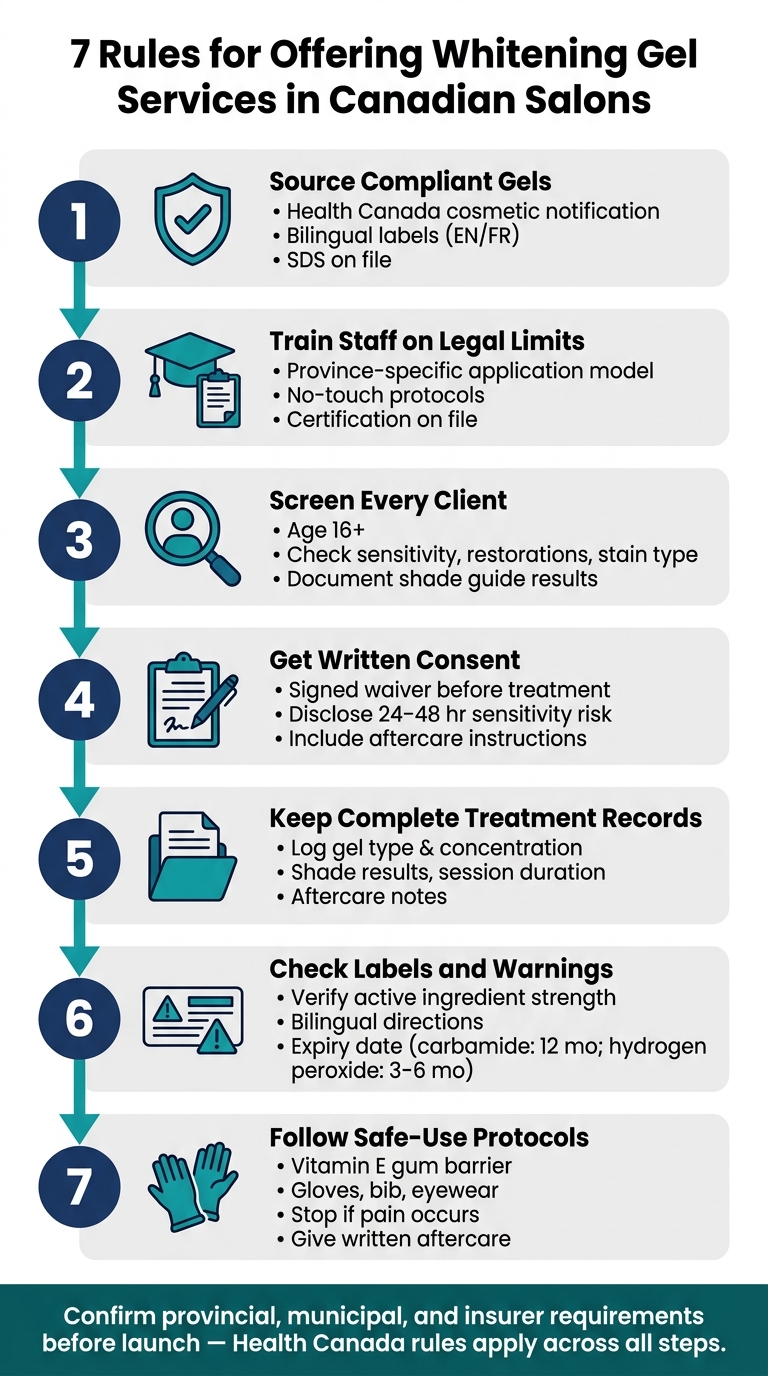
7 Rules for Offering Whitening Gel Services in Canadian Salons
Are Teeth Whitening Businesses LEGAL with No Dental Experience??
sbb-itb-accb75b
What Canadian Salons Need to Know Before Offering Whitening
Peroxide-based whitening gels must meet Health Canada cosmetic rules before you can sell them or use them in a salon setting.
That’s the first thing to get straight.
The next piece is licensing and application rules. Those can change depending on the province or even the city. Some provinces limit who can apply whitening products. Others allow client-applied trays with staff guidance. So the rules aren’t one-size-fits-all across Canada.
Labels matter just as much. In Canada, compliant whitening gels need bilingual labelling and clear directions for professional use. If the packaging is vague, incomplete, or English-only, that’s a red flag.
There’s also a product-side difference to know. Carbamide peroxide is the more stable option. Hydrogen peroxide is subject to tighter concentration limits.
Once those basics are in place, the next step is to source only compliant gels.
1. Source Only Health Canada-Compliant Whitening Gels
Once you know the ground rules, check every gel supplier before you place an order. Only buy gels with clear Health Canada cosmetic notification details and full supplier paperwork. Ask for that documentation before you buy, not after.
The product also needs to match your salon’s approved concentration limits. Those limits change based on the type of peroxide in the gel, so confirm the formula fits what your province and insurer allow.
Keep these documents on file for each gel:
- product invoices
- bilingual ingredient lists
- Health Canada cosmetic notification details
- Safety Data Sheets (SDS)
Set up one compliance file per gel. That gives your team one place to check during the rest of the treatment process.
You’ll also want insurer approval for each gel, concentration, and application method before staff use it. Coverage can change based on both concentration and how the gel is applied, so keep the insurer’s approval note in the same product file to avoid coverage gaps.
Next, make sure staff know exactly how to apply the gel within legal limits.
2. Train Staff on Safe Application and Legal Limits
Once you have compliant gels in place, train staff on the exact application model allowed in your area.
Who can apply whitening gel varies by province, city, and local health authority. In many regions, non-dental staff stay compliant by guiding the client to insert the tray themselves. Before any treatment, confirm the allowed application model with your local health authority.
Training should cover the basics that matter day to day:
- no-touch procedures
- hygiene
- contraindications
- safe product handling
Staff should also learn how to isolate gums and lips using silicone cheek retractors, follow exact application times, and give clear aftercare instructions. This part matters. Small mistakes can create big problems.
Keep a training file for each staff member. Include their certification, the training curriculum, and proof that no-touch protocols were covered. Add the Safety Data Sheets (SDS) for each gel used as well, so there’s a clear record that staff were informed of hazards and handling procedures.
Once staff are trained, screen every client before each treatment.
3. Screen Every Client Before Each Treatment
Screen before every treatment, not just at intake. Use the same screening process at every appointment so nothing slips through the cracks.
Some clients should not get peroxide treatment. Avoid high-strength peroxide gels for anyone with sensitive teeth or gums. Watch for crowns, veneers, and fillings too, since peroxide does not whiten those materials. Treatment should be limited to clients aged 16 and older. You also need to tell whether the stain is extrinsic or intrinsic so you can match the treatment and set clear expectations.
Document each screening session with care. The intake record should include:
- the client's sensitivity history
- the stain type
- the initial tooth shade measured with a shade guide
Record the screening results before treatment begins.
If the client passes screening, move to written consent and disclosures.
4. Use Written Consent and Clear Disclosures
After screening, put the risks and limits in writing before treatment starts. Have the client sign a consent form with waiver language before the session begins. This helps confirm informed consent and gives you a clear record.
The form should explain that temporary sensitivity or gum irritation may happen and usually settles within 24–48 hours. It should also state that restorations such as crowns, veneers, and fillings will not whiten. Add a short note confirming that the client understands the risks and limits of whitening.
Include aftercare instructions in the same form. Clients should be told in writing to avoid very hot or cold foods and drinks for two hours after treatment.
A few details matter here:
- Match the waiver language to your insurer's requirements.
- Use a standard waiver template so you don't miss required disclosures.
- File the signed consent with the treatment record.
5. Keep Complete Treatment Records
Once consent is signed, the treatment record becomes your main compliance file. That means every treatment needs its own session record, and each visit should be logged on a separate record, then updated when the client comes back.
Here’s what each treatment record should include:
| Component | What to Document |
|---|---|
| Client Intake & Consent | Signed consent form and contact details |
| Medical Screening | Contraindications and sensitivity history |
| Shade Guide Results | Starting and ending shade using a standard shade guide |
| Product Details | Gel type and concentration |
| Procedure Used | Steps followed and session duration |
| Aftercare Note | Aftercare note and any client response |
The key point is simple: your records should line up with the gel label, the consent form, and the treatment that was actually carried out.
You’ll also need to keep the Safety Data Sheet (SDS) for every whitening gel you use on file, in a spot where staff can get to it fast.
It’s also smart to line up your recordkeeping with your insurer’s documentation rules.
6. Check Labels, Warnings, and Directions
When the gel arrives, check the label before you put it into use. This isn’t the same as the sourcing review. That step happened earlier. This is the receiving check for the gel you’ve already approved.
The label needs to clearly show the active ingredient and its strength - for example, 35% carbamide peroxide - plus bilingual directions for professional use.
Also check the warnings. If the label leaves out sensitivity or gum-irritation warnings, don’t use the product. Pull it from service.
Expiry date matters too. Carbamide peroxide gels can stay stable for up to 12 months from purchase, while hydrogen peroxide gels often last only 3 to 6 months. Stock that’s close to expiry shouldn’t make it into the treatment room.
Check each shipment when it arrives. Labels can change from one shipment to the next.
If the label fails any part of this check, hold the gel out of service until the issue is fixed.
7. Follow Safe-Use Rules During and After Treatment
Once the product, client, and consent checks are done, keep the treatment under close control.
Start by applying Vitamin E swabs to the client's gum line and the inner and outer lips before the gel goes on. This helps form a barrier and calm the soft tissue.
From there, use only the approved gel. Keep it away from soft tissue, and follow the protocol for gloves, a bib, and protective eyewear.
If the client reports pain, burning, or strong irritation at any point, stop the session right away. Treat the irritation at once and follow the SDS.
After treatment, document the result and send the client home with aftercare instructions. Give the client written aftercare instructions before they leave. Record the post-treatment shade, exposure time, and any sensitivity.
Compliance Checklist for Salon Owners
Use this checklist before you book your first whitening client. Skip even one item, and you could end up dealing with liability.
Think of this as your final file check before you offer the service to clients.
| Checklist Category | What to Confirm |
|---|---|
| Supply Source | Health Canada-compliant supplier; invoices, ingredient lists, and expiry dates on file |
| Staff Training | Certified staff file and training sign-off on file |
| Client Intake | Screening form complete; sensitivity, restorations such as crowns, veneers, or fillings, and age 16+ confirmed |
| Signed Consent | Signed consent form filed before treatment |
| Treatment Record | Pre- and post-treatment shade guide results logged; gel strength and protocol noted |
| Lot & Batch Logging | Lot/batch number recorded for every syringe or kit used |
| Label Review | Full ingredient list, expiry date checked, and mandatory warnings confirmed on each product |
| Safe Use | Gloves, bib, eyewear, gum barrier, and stop-treatment protocol used; aftercare given |
| Insurance | Written confirmation from your insurer that whitening treatments are covered |
| Local Regulations | Local health authority licensing requirements confirmed |
This isn’t busywork. It’s the paper trail that shows your salon took the right steps, used the right products, and treated the client with care.
Conclusion
Use the checklist above as your last pre-launch review. These seven controls need to work as a set: compliant sourcing, trained staff, client screening, written consent, records, labels, and safe use.
If even one rule feels fuzzy, stop and confirm it before you offer the service.
Before launch, check provincial, municipal, and insurer requirements with your local health authority. Do not launch until the rules are clear.
FAQs
Do I need a licence to offer whitening gel in my salon?
There’s no specific licence required to start a teeth whitening business in Canada.
That said, the rules can change depending on your province or municipality. So before you open your doors, check your local requirements and speak with your public health authority.
Even if the government doesn’t ask for a licence, your insurer might still want to see professional teeth whitening certification before offering coverage. You’ll also need to make sure your whitening gels comply with Health Canada cosmetic rules and that your business follows local, provincial, and national standards.
What peroxide concentration is allowed in Canada?
In Canada, Health Canada sets peroxide limits for tooth-whitening safety.
For over-the-counter products, the limit is less than 0.1% hydrogen peroxide. Products with 0.1% to 6% are for professional use and need supervision from a dental professional.
There’s another rule once the formula goes above 3% hydrogen peroxide, or the equivalent amount from another peroxide source. In that case, manufacturers need clinical studies showing that salivary peroxide stays below 3% during treatment.
All tooth-whitening products must also have a pH of at least 4.0.
What records should I keep for each whitening treatment?
Keep clear records for each whitening treatment. That should include the client’s starting tooth shade, along with photos that show the matching shade tab.
You’ll also want signed consent forms and waivers on file, plus current MSDS for every product you use and your SOP manuals. Public health inspectors may ask to see these during site visits.